

The Search Landscape Has Already Shifted
For twenty years, showing up on Google was enough. You published content, optimized for keywords, earned backlinks, and waited for organic traffic to arrive. That playbook worked because users had no alternative — they typed a query, scanned ten blue links, and clicked.
That era is ending.
Today, millions of users skip Google entirely. They ask ChatGPT for product recommendations. They use Perplexity to research vendors. They rely on Claude to summarize complex topics. When an AI engine answers a question, it doesn't serve ten links — it delivers one synthesized response, often citing just two or three sources.
If your brand isn't one of those cited sources, you're invisible.
This is the problem that generative engine optimization solves. GEO is the discipline of structuring your brand's content, authority, and data so that AI-powered search engines cite you in their responses. It's not a rebrand of SEO. It's a fundamentally different practice built for a fundamentally different architecture.
In this guide, we'll break down exactly what GEO is, how it differs from traditional SEO, and what it takes to get your brand into AI-generated answers in 2026.
What Is Generative Engine Optimization?
Generative engine optimization (GEO) is the practice of optimizing your brand's digital presence so that AI-powered search engines — like ChatGPT, Perplexity, Google AI Overviews, and Claude — cite, reference, and recommend your content in their generated responses. Where SEO optimized for ranking positions, GEO optimizes for citation in AI-synthesized answers.
The Problem: Traditional Search Is Shrinking
The numbers tell a stark story. Gartner predicted in 2024 that traditional search engine volume would drop 25% by 2026 as consumers shifted to AI chatbots and virtual agents (Gartner, 2024). We are now in 2026, and that shift is well underway.
The zero-click trend has accelerated the problem. Research from Rand Fishkin and SparkToro found that roughly 60% of Google searches in 2024 ended without a click to any website (SparkToro, 2024). With Google's own AI Overviews now answering queries directly at the top of results, that percentage has only grown.
Meanwhile, AI search tools are surging in adoption:
- ChatGPT reached over 200 million weekly active users by late 2024 (OpenAI, 2024)
- Perplexity processes tens of millions of queries monthly and has positioned itself as a direct Google competitor
- Google AI Overviews now appear on a significant share of search queries in the US, reducing clicks to traditional organic results
For brands, this creates a compounding visibility crisis. Your content may still rank on page one of Google, but if users never click — or never even reach Google — that ranking is worth less every quarter.
The businesses feeling this most acutely are those in competitive informational categories: B2B SaaS, fintech, health and wellness, e-commerce, and professional services. These are the sectors where buyers research extensively before purchasing, and where AI engines are rapidly becoming the first stop.
If you want to understand the deeper structural forces behind this shift, our introduction to GEO covers the transition from the link economy to the generative economy in detail.
The Solution: What GEO Actually Does
Generative engine optimization addresses the visibility gap by working with how AI engines source, evaluate, and cite information. Rather than optimizing for crawler algorithms, GEO optimizes for the reasoning layer of large language models.
Here's what that means in practice:
- Structured authority signals. AI engines pull from sources they deem authoritative. GEO ensures your brand's expertise is structured in formats that models can parse, evaluate, and trust.
- Citation-worthy content. LLMs favor content that provides clear, specific, well-sourced answers. GEO produces content designed to be the answer an AI engine cites, not just a page that ranks.
- Entity and brand presence. AI models build internal representations of brands, people, and concepts. GEO strengthens your brand's presence across the data sources these models draw from.
- Technical discoverability. Ensuring your content is accessible to AI crawlers, properly structured with schema markup, and not blocked by configurations that prevent AI indexing.
GEO vs. Traditional SEO
| Dimension | Traditional SEO | Generative Engine Optimization |
|---|---|---|
| Optimizes for | Search engine ranking positions | AI-generated citations and recommendations |
| Success metric | Clicks, impressions, keyword rankings | Brand mentions in AI responses, citation rate |
| Content strategy | Keyword-targeted pages and blog posts | Authoritative, structured, citation-worthy content |
| Technical focus | Page speed, crawlability, backlinks | Schema markup, entity clarity, AI crawler access |
| Competitive landscape | Competing for 10 organic spots | Competing for 1-3 cited sources per AI answer |
| Timeline to results | 3-6 months for ranking changes | Ongoing; model training and retrieval cycles vary |
It's worth noting that GEO doesn't replace SEO — it layers on top of it. Strong SEO fundamentals (clean site architecture, quality content, earned backlinks) still contribute to how AI models evaluate your authority. But SEO alone is no longer sufficient.
Results, Not Dashboards
Most marketing tools give you a platform and leave execution to your team. You get dashboards, audit reports, and recommendation lists — and then the real work begins.
Voyage (onvoyage.ai) takes a different approach. Instead of handing you a to-do list, Voyage delivers finished work: research completed, content generated, site changes implemented, all delivered as a GitHub pull request your engineering team can review and merge. The distinction matters because GEO is execution-heavy. Knowing what to optimize is the easy part. Actually doing it — at scale, across your entire content surface — is where most teams stall.
How Generative Engine Optimization Works
While specific tactics vary by industry and AI platform, effective GEO follows a consistent process. Here's the four-step framework that produces results.
Step 1: Research and Analyze
Before optimizing anything, you need to understand your current position in the AI landscape. This means:
- AI citation audit. Query the major AI engines (ChatGPT, Perplexity, Claude, Gemini) with your target keywords and map where your brand appears — and where it doesn't.
- Competitor citation analysis. Identify which brands are being cited in your category and study what makes their content citation-worthy.
- Source mapping. Understand which data sources each AI engine draws from for your industry, including knowledge bases, review platforms, and authoritative publications.
This research phase reveals the gaps between where you are and where you need to be.
Step 2: Site Audit
With research in hand, the next step is auditing your existing digital presence for AI readiness:
- Is your content structured so that AI engines can extract clear, citable answers?
- Does your schema markup accurately represent your brand's entities, products, and expertise?
- Are AI crawlers able to access your content, or are they blocked by robots.txt rules?
- Do your pages provide the specificity and sourcing that models favor, or do they rely on vague, generic language?
The audit produces a prioritized list of technical and content changes.
Step 3: Content Generation
This is where most of the work happens. Based on the research and audit, new content is created and existing content is restructured to maximize citation potential:
- Answer-first content that leads with clear, definitive statements AI engines can extract
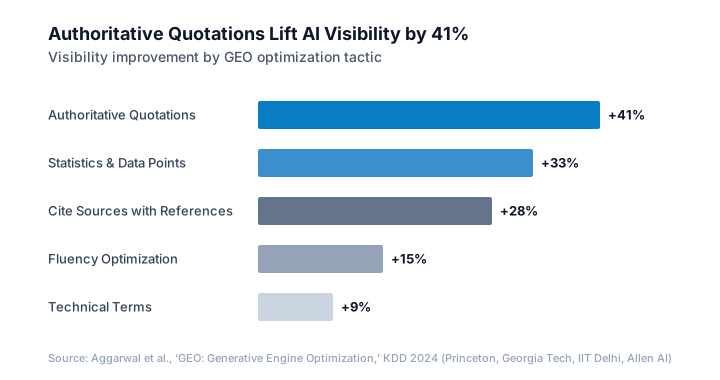
- Statistical and data-driven claims with proper sourcing that models treat as authoritative
- Entity-rich pages that strengthen your brand's presence in the knowledge graphs models rely on
- FAQ and structured Q&A formats that map directly to how users query AI engines
Content generation for GEO is not about volume. It's about precision — creating the specific pages and structures that position your brand as the source an AI engine trusts.
Step 4: Deliver via GitHub PR
The final step is implementation. In Voyage's workflow, all changes — content updates, schema additions, technical fixes — are packaged as a GitHub pull request. This means:
- Your engineering team reviews every change before it goes live
- There's a clear audit trail of what changed and why
- Changes can be merged incrementally or all at once
- No access to your CMS or production environment is required
This delivery model keeps your team in control while eliminating the bottleneck of manual implementation.
Who Needs GEO? Three Use Cases
Generative engine optimization is relevant to any brand that depends on being discovered through search. But some scenarios make the urgency especially clear.
Use Case 1: Head of Growth at a B2B SaaS Company
The situation. Your company sells project management software. You've invested heavily in SEO for three years and rank on page one for dozens of high-intent keywords. But organic traffic has plateaued — or declined — over the past two quarters despite stable rankings.
The GEO problem. When prospects ask ChatGPT "what's the best project management tool for remote teams," your product doesn't appear in the response. Three competitors do. Those competitors are getting considered before prospects ever reach Google.
The GEO solution. An AI citation audit reveals that your product pages lack the structured, comparison-ready content that models favor. Your competitor's content includes specific feature comparisons, quantified customer outcomes, and third-party review data that models treat as authoritative. GEO-driven content restructuring and entity optimization puts your brand into the AI answer within one to two model update cycles.
Use Case 2: CMO at an E-Commerce Brand
The situation. You run marketing for a direct-to-consumer skincare brand. Paid acquisition costs have risen 40% year over year. You need organic channels to carry more weight, but Google's AI Overviews are eating your click-through rates on informational queries.
The GEO problem. Queries like "best vitamin C serum for sensitive skin" now show an AI Overview that cites three brands — none of them yours. Users get their answer without scrolling to organic results.
The GEO solution. GEO optimization focuses on your product detail pages, ingredient education content, and third-party review presence. By structuring your content with clinical data, specific formulation details, and clear schema markup, your brand becomes the authoritative source that both Google's AI Overviews and standalone AI engines reference.
Use Case 3: Founder of an Early-Stage Startup
The situation. You've just launched a developer tool. You have no domain authority, minimal backlinks, and a small content library. Traditional SEO will take 12-18 months to produce meaningful traffic.
The GEO problem. You can't wait 18 months. Your competitors are already being cited by AI engines, and every day they're mentioned reinforces their position in model training data.
The GEO solution. GEO offers a faster path to visibility for new brands because AI engines evaluate content quality and specificity differently than Google's link-based authority model. By publishing deeply technical, well-sourced content from day one — structured for AI citation — a startup can appear in AI-generated responses even without traditional domain authority. This doesn't replace SEO investment, but it opens a parallel channel while your organic presence matures.
For more on how the GEO landscape is evolving across industries, explore our blog for the latest analysis and case studies.
Frequently Asked Questions
Is GEO replacing SEO?
No. GEO and SEO address different discovery channels that increasingly overlap. SEO still matters for traditional search, and strong SEO signals (authoritative backlinks, clean site structure, quality content) also contribute to how AI models evaluate your brand. Think of GEO as an additional layer, not a replacement. Brands that invest in both will have the broadest visibility.
How long until GEO shows results?
Timelines depend on the AI engine. Retrieval-augmented generation (RAG) systems like Perplexity pull from live web data, so content changes can affect citations within days or weeks. Model-based systems like ChatGPT depend on training data cycles, which can take weeks to months. A practical GEO strategy targets quick wins on RAG-based engines while building for longer-term model training influence.
What's the difference between GEO and AEO?
Answer engine optimization (AEO) is sometimes used interchangeably with GEO, but there's a useful distinction. AEO typically refers to optimizing for featured snippets and direct answers within traditional search engines. GEO is broader — it encompasses optimization for standalone AI engines (ChatGPT, Claude, Perplexity) in addition to AI features within traditional search. As AI-native search tools grow, GEO is becoming the more accurate and comprehensive term.
How much does GEO cost?
Costs vary widely depending on scope. A basic AI citation audit might run a few thousand dollars. A full GEO program — including research, content generation, technical optimization, and ongoing monitoring — typically ranges from $3,000 to $15,000 per month depending on the size of your content surface and the competitiveness of your category. The key cost consideration is execution: many brands underestimate the content production and technical work required to implement GEO recommendations.
Can I do GEO myself?
You can, especially if your team has strong content and technical SEO capabilities. The core practices — auditing AI citations, structuring content for extractability, building entity authority — are learnable. The challenge is scale. GEO requires ongoing monitoring across multiple AI platforms, continuous content production, and technical implementation. Most teams find that the execution burden is what makes an outside partner or platform valuable, not the strategy itself.
What Comes Next
The shift from traditional search to AI-generated answers is not a future prediction. It's happening now. Every quarter, more users bypass Google. More buying decisions are influenced by AI-generated recommendations. More brands discover that their hard-won search rankings no longer deliver the traffic they once did.
Generative engine optimization is how you adapt. Not by abandoning SEO, but by extending your visibility into the AI engines that are rapidly becoming the front door to the internet.
The brands that act now will compound their advantage. AI models learn from repetition and authority — the earlier your content enters the citation cycle, the harder it becomes for competitors to displace you.
If you want to understand where your brand stands in AI search today, and what it would take to get cited, book a demo with Voyage. No dashboards. No recommendation decks. Just the research, content, and implementation delivered as pull requests your team can ship.