

The generative engine optimization market has grown fast. In 2025, GEO was a niche concern for forward-thinking marketing teams. By early 2026, it has become a category unto itself, with dedicated platforms, venture funding, and a growing pool of buyers trying to figure out which tool actually works.
Estimates from multiple industry analysts put the GEO and AI visibility market on track to surpass $1.5 billion in annual spend by the end of 2026. That growth has attracted a wave of new entrants — monitoring dashboards, analytics suites, agent-based platforms, and full-service solutions all competing for budget.
But here is the problem most buyers run into: the majority of GEO tools show you data. They do not move the needle. You get dashboards, charts, and brand mention counts. What you do not get is improved AI visibility.
This guide compares seven GEO platforms across pricing, capabilities, and delivery model. The goal is simple — help you pick the tool that matches what your team actually needs. If you are new to the space, start with our introduction to generative engine optimization.
What Are the Best GEO Platforms?
The best GEO platforms in 2026 are Voyage (best for done-for-you execution), Profound (best for enterprise monitoring), Scrunch (best for agent-based optimization), Peec AI (best for analytics), Otterly (best for tracking), Goodie AI (best for content teams), and Ahrefs Brand Radar (best for SEO teams adding GEO).
The Real Problem with Most GEO Tools
The GEO market is following a familiar pattern. When SEO became mainstream, the first wave of tools focused on tracking — keyword rankings, backlink counts, domain authority scores. Optimization came later.
GEO is repeating that cycle. Most platforms today are monitoring tools dressed up as optimization platforms. They tell you how often ChatGPT, Gemini, or Perplexity mention your brand. They track sentiment. They show you competitor comparisons.
That information is useful. But it does not change your AI visibility on its own.
The monitoring gap
Here is what typically happens when a team adopts a monitoring-only GEO tool:
| Step | What happens | Outcome |
|---|---|---|
| 1 | Buy platform, connect brand | Dashboard populates |
| 2 | See low AI mention rates | Team gets concerned |
| 3 | Read recommendations | Generic advice appears |
| 4 | Try to implement changes | No clear workflow |
| 5 | Check dashboard again | Metrics barely move |
The gap between "knowing your AI visibility is low" and "actually improving it" is where most teams get stuck. Monitoring platforms identify the problem. They rarely solve it.
According to a 2025 Gartner survey on AI-driven marketing, over 60% of marketing leaders said they lacked the internal expertise to act on AI visibility data. The tools gave them signal. They did not give them execution.
What actually moves the needle
Improving AI visibility requires a specific set of actions: auditing how AI models currently reference your brand, identifying content gaps, generating optimized content, and publishing it where AI training pipelines can ingest it.
That is a workflow, not a dashboard. The platforms in this guide fall on a spectrum from pure monitoring to full execution. Understanding where each tool sits on that spectrum is the key to making the right choice.
For a deeper look at the mechanics behind generative engine optimization, read our full explainer on what GEO is and why it matters.
The 7 Best GEO Platforms: Full Comparison
Here is how the top platforms compare across the criteria that matter most.
| Platform | Pricing | AI Models Covered | Monitoring | Content Generation | Content Delivery | Best For |
|---|---|---|---|---|---|---|
| Voyage | Custom | ChatGPT, Gemini, Perplexity, Claude, DeepSeek | Yes | Yes (AI-generated) | GitHub PR delivery | Teams that want results, not dashboards |
| Profound | $99–custom/mo | ChatGPT, Gemini, Perplexity | Yes (core feature) | No | No | Enterprise brand monitoring |
| Scrunch | $250–custom/mo | ChatGPT, Gemini, Perplexity | Yes | Yes (via AXP agent) | Agent-based | Teams building GEO workflows |
| Peec AI | Free tier–custom | ChatGPT, Gemini | Yes | No | No | Analytics and tracking |
| Otterly | $39–$299/mo | ChatGPT, Gemini, Perplexity | Yes (core feature) | No | No | AI search tracking |
| Goodie AI | Custom | ChatGPT, Gemini | Limited | Yes | Manual | Content-focused teams |
| Ahrefs Brand Radar | Included with Ahrefs plan | ChatGPT, Gemini, Perplexity | Yes | No | No | Existing Ahrefs users |
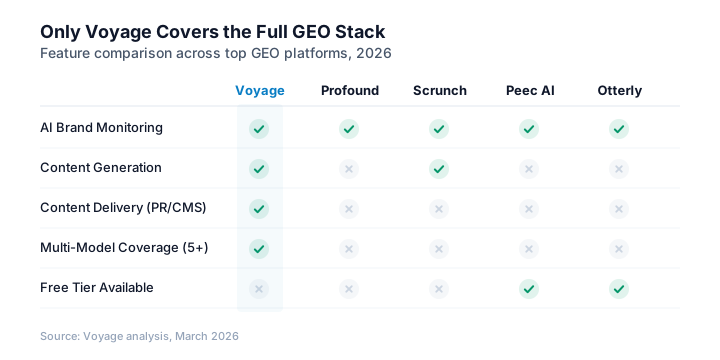
Now let's look at each platform individually.
1. Voyage — Best for Done-for-You GEO
Voyage takes a fundamentally different approach from every other platform on this list. Instead of giving you a dashboard and leaving you to figure out what to do, Voyage performs the research, runs the audit, generates optimized content, and delivers the finished work as a GitHub pull request.
The workflow is straightforward: Voyage's system analyzes how AI models currently reference your brand, identifies gaps and opportunities, generates content designed to improve your visibility, and delivers it directly into your codebase or CMS via PR.
| Strengths | Limitations |
|---|---|
| End-to-end execution | Custom pricing (no self-serve tier) |
| Covers 5+ AI models including DeepSeek and Claude | Newer platform |
| No internal team bandwidth required | Requires GitHub-based workflow |
| Content generation + delivery in one | Less suited for teams that want manual control |
Voyage is best for teams that have identified AI visibility as a priority but do not have the bandwidth or expertise to execute a GEO strategy internally. The PR-based delivery model means every change is reviewable, version-controlled, and auditable.
2. Profound — Best for Enterprise Monitoring
Profound is one of the most established names in GEO monitoring. Plans start at $99 per month and scale to custom enterprise pricing. The platform focuses on tracking how AI models mention your brand, analyzing sentiment, and benchmarking you against competitors.
| Strengths | Limitations |
|---|---|
| Mature monitoring dashboard | No content generation |
| Competitor benchmarking | No content delivery |
| Strong data visualization | Monitoring-only — execution is up to you |
| Enterprise-grade reporting | Higher tiers needed for full feature set |
Profound excels at answering the question "how visible is my brand in AI responses?" It does not answer "what should I do about it?" Teams that already have content and SEO resources in-house can use Profound's data to guide their own GEO efforts.
3. Scrunch — Best for Agent-Based GEO Workflows
Scrunch positions itself as an AXP (AI Experience Platform) with agent-based optimization. Plans start at $250 per month and go to custom pricing for enterprise. The platform uses AI agents to analyze and recommend optimizations.
| Strengths | Limitations |
|---|---|
| Agent-based approach | Higher starting price ($250/mo) |
| AXP platform concept | Steeper learning curve |
| Active optimization, not just monitoring | Newer category — less proven at scale |
| Covers major AI models | Custom pricing for full features |
Scrunch is a strong option for technically sophisticated teams that want an agent-based system they can configure and direct. It sits between pure monitoring (Profound) and full execution (Voyage) on the spectrum.
4. Peec AI — Best for Analytics and Tracking
Peec AI focuses on the analytics side of GEO. The platform offers a free tier, making it accessible to smaller teams testing the GEO waters. Its core strength is tracking and analyzing how AI engines reference brands and topics.
| Strengths | Limitations |
|---|---|
| Free tier available | No content generation |
| Clean analytics interface | Limited AI model coverage |
| Good entry point for GEO | Analytics only — no execution |
| Affordable | Feature set is narrower than competitors |
For teams that just want to understand their current AI visibility without committing to a large budget, Peec AI is a solid starting point. But like Profound, the gap between data and action remains.
5. Otterly — Best for AI Search Tracking
Otterly focuses specifically on tracking brand visibility across AI-powered search experiences. Plans range from approximately $39 to $299 per month. The platform monitors how brands appear in AI search results from ChatGPT, Gemini, and Perplexity.
| Strengths | Limitations |
|---|---|
| Dedicated AI search tracking | No content generation |
| Affordable entry point | Monitoring only |
| Clean, focused interface | No delivery or execution |
| Regular tracking updates | Limited to search-style queries |
Otterly is a good fit for teams that want a lightweight, affordable way to track AI search mentions without the complexity of a full GEO platform.
6. Goodie AI — Best for Content-Focused Teams
Goodie AI emphasizes content optimization for AI visibility. The platform helps teams create and optimize content that is more likely to be referenced by generative AI models.
| Strengths | Limitations |
|---|---|
| Content generation capabilities | Limited monitoring |
| Focus on content quality | Manual delivery (no automated publishing) |
| AI content optimization | Custom pricing only |
| Good for content teams | Less comprehensive than full-stack platforms |
Goodie AI is a reasonable choice for content teams that already have a publishing workflow and want help generating AI-optimized material. The lack of automated delivery means more manual work than a platform like Voyage.
7. Ahrefs Brand Radar — Best for Existing Ahrefs Users
Ahrefs added Brand Radar as a feature within its existing SEO platform. For teams already paying for Ahrefs, this provides GEO monitoring without an additional tool purchase.
| Strengths | Limitations |
|---|---|
| Included with Ahrefs subscription | Basic GEO features |
| Familiar interface for SEO teams | Not a dedicated GEO platform |
| No additional cost | No content generation or delivery |
| Bridges SEO and GEO data | GEO is a secondary feature, not core |
Ahrefs Brand Radar is the path of least resistance for teams already using Ahrefs. It provides basic AI visibility monitoring, but it is not a replacement for a dedicated GEO platform if AI visibility is a strategic priority.
Use Cases: Which Platform Fits Your Team?
Different teams have different needs. Here are three common scenarios and the platforms that best fit each.
Scenario 1: Enterprise marketing team with 20+ people
Your team has content writers, SEO specialists, and a marketing ops function. You have the bandwidth to act on data — you just need the right signal.
Best fit: Profound + internal execution, or Voyage for turnkey results.
An enterprise team can use Profound's detailed monitoring to understand their AI visibility landscape. The data feeds into existing content workflows. Alternatively, teams that are stretched thin on bandwidth can use Voyage to skip the analysis-to-execution gap entirely.
| Consideration | Profound | Voyage |
|---|---|---|
| Team bandwidth required | High | Low |
| Time to first result | Weeks (depends on execution) | Days |
| Control over content | Full (you create it) | Review-based (PR approval) |
| Monthly cost | $99–custom | Custom |
Scenario 2: Growth-stage startup (5-15 people)
You are resource-constrained. Your marketing team is small. You know AI visibility matters but you cannot dedicate a full-time person to it.
Best fit: Voyage or Peec AI.
Startups should either go lightweight (Peec AI's free tier for basic tracking) or go all-in on execution (Voyage, where the platform does the work). The worst option is buying a monitoring tool that surfaces problems your team cannot solve.
For growth-stage companies, the cost of inaction is high. AI models are forming opinions about your category right now. Every month without optimized content is a month where competitors are training the AI to favor them.
Scenario 3: Agency managing 10+ client brands
You need scalability, reporting, and the ability to deliver results across multiple accounts.
Best fit: Scrunch or Voyage.
Agencies benefit from platforms that scale across multiple brands. Scrunch's agent-based model can be configured per client. Voyage's PR-based delivery provides a clean handoff to client engineering teams.
| Need | Scrunch | Voyage |
|---|---|---|
| Multi-brand management | Yes (AXP agents) | Yes (per-brand PRs) |
| Client-facing reports | Yes | Yes |
| Scalability | Agent-based | Service-based |
| Starting price | $250/mo | Custom |
Frequently Asked Questions
Which GEO tool is best for small teams?
For small teams with limited budget, Peec AI's free tier provides basic AI visibility tracking. For small teams that want actual results without dedicating internal resources, Voyage is the better investment — it handles execution so your team does not have to.
The worst choice for a small team is a mid-tier monitoring dashboard. You will pay for data you do not have the bandwidth to act on.
Do I need a GEO platform if I already use Ahrefs?
Ahrefs Brand Radar gives you basic AI mention tracking, but it is not a substitute for a dedicated GEO strategy. Ahrefs is an SEO tool with GEO features bolted on. If AI visibility is a real priority — not just a nice-to-have — you need a platform built for GEO from the ground up.
That said, Brand Radar is a fine starting point for understanding the basics.
How much do GEO platforms cost?
Pricing ranges from free (Peec AI's basic tier) to $250+ per month (Scrunch) to custom enterprise pricing (Voyage, Profound's higher tiers). The market has not standardized on pricing yet.
| Tier | Platforms | Monthly cost |
|---|---|---|
| Free / Low cost | Peec AI, Otterly (basic) | $0–$39/mo |
| Mid-range | Profound, Otterly (pro), Scrunch | $99–$250+/mo |
| Enterprise / Custom | Voyage, Profound (enterprise), Scrunch (enterprise) | Custom |
As a general rule, monitoring tools are cheaper. Execution platforms cost more but deliver more.
Profound vs Scrunch — which is better?
It depends on what you need. Profound is the better pure monitoring tool — its dashboards are mature and its competitor benchmarking is strong. Scrunch is better if you want agent-based optimization that goes beyond monitoring.
Profound is the safer choice for teams that want visibility data. Scrunch is the more ambitious choice for teams that want an AI agent working on their behalf.
Neither delivers finished content to your codebase. For that, look at Voyage.
What is the fastest way to improve AI visibility?
The fastest path is direct content optimization — creating and publishing content specifically designed to be referenced by AI models. This means structured data, authoritative sourcing, and strategic placement on platforms that AI training pipelines crawl frequently.
A monitoring dashboard will not speed this up. A platform that handles research, content generation, and delivery (like Voyage) will. For a detailed breakdown of GEO mechanics, see our guide to generative engine optimization.
Conclusion
The GEO platform market in 2026 offers real options across every budget and team size. But the most important decision is not which tool to buy — it is what kind of tool you need.
If your team has the bandwidth and expertise to act on monitoring data, platforms like Profound and Peec AI provide strong visibility tracking. If you want an agent-based system you can configure, Scrunch is worth evaluating. If you already use Ahrefs, Brand Radar is a free add-on.
But if you want results — content researched, generated, and delivered without requiring your team to become GEO experts — Voyage is the platform built for that. No dashboards to interpret. No recommendations to implement manually. Just optimized content, delivered as a pull request, ready for review.
The AI models are forming opinions about your brand right now. The question is whether you are shaping those opinions or leaving them to chance.